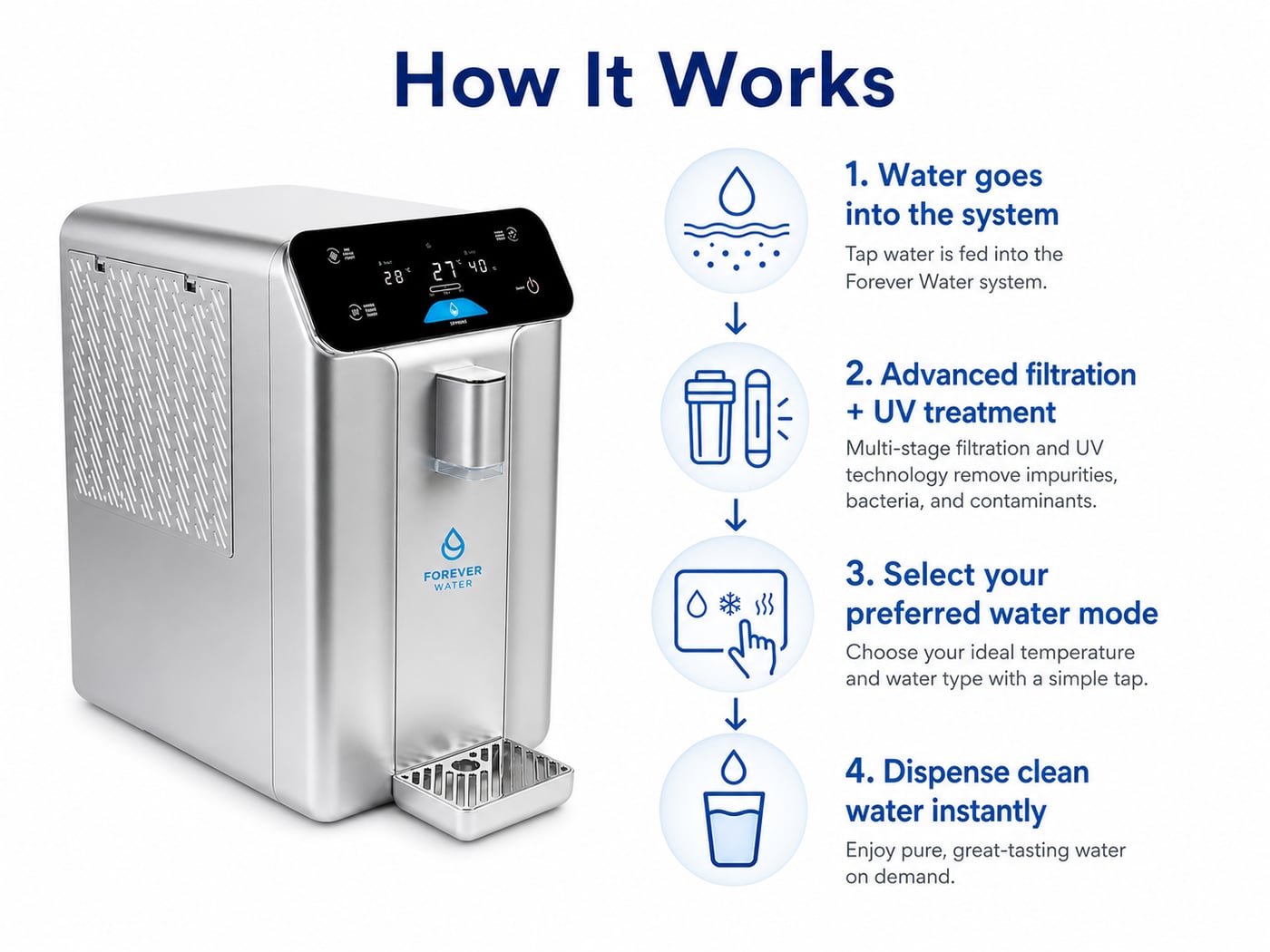
An atmospheric water generator is a clever hybrid: it's part dehumidifier, part water filter, part mini-fridge. The result is up to 10 litres a day of pure drinking water, made from the air in your kitchen. Here's how the science actually works — and whether your home has the conditions to make one effective.
The basic physics: dew on a glass
If you've ever pulled a cold drink out of the fridge and seen condensation form on the outside, you've watched an atmospheric water generator at work in slow motion. Air contains water as invisible vapour. When that warm, humid air contacts a surface colder than its dew point, the water vapour condenses into liquid.
An AWG industrialises this. A small refrigeration system chills a metal coil to ~3 °C. A fan draws room air across the coil. Moisture in the air condenses on the coil and drips into a collection tank. That tank water is then filtered, sterilised and chilled.
How much water can it actually make?
Output depends on three variables:
- Air temperature. Warmer air holds more moisture. AWG output peaks at 25–32 °C.
- Relative humidity. The percentage of how much moisture the air is holding compared to its maximum. Below 35% RH, condensation barely happens.
- Coil surface area & airflow. Bigger coil + faster fan = more water (and more electricity).
The Forever Water A10 is rated at 10 L/day at 30 °C / 80% RH. In a more typical Australian household environment (~22 °C / ~60% RH), it produces around 5–7 L/day — perfect for a family of four's drinking needs.
Will it work where you live?
The short answer: virtually all populated coastal Australia, year-round. The threshold of 35% relative humidity is pretty easy to clear:
- Brisbane / Gold Coast / Sunshine Coast: avg 65–75% RH
- Sydney: avg 60–70%
- Melbourne: avg 55–65%
- Perth: avg 50–60%
- Adelaide: avg 45–55%
- Cairns / Darwin: 70–80%+
- Hobart: 60–70%
Where it struggles: parts of inland WA (Goldfields), Outback SA/NT, and inland NSW in dry summer conditions. If you're in one of these, we tell you upfront.
What about indoor air vs outdoor?
Common question. The answer is that indoor humidity is usually slightly lower than outdoor (because air conditioners dehumidify), but the difference is rarely enough to push you below the 35% threshold. The A10 sits inside, not outdoors, and uses your kitchen's air.
Filtering the water it makes
Here's where AWG gets interesting compared to bottled or tap water. The water that condenses on the coil is essentially distilled water with airborne particulates. No chlorine, no fluoride, no PFAS, no microplastics — those things require a delivery vehicle (pipes, plastic bottles, contaminated source water) which AWG doesn't have.
What it does have: dust particles from your room air, possible volatile organic compounds, possible bacteria/mould spores. Hence the multi-stage filter:
- Electrostatic dust filter on the air intake
- Pre-Carbon (10 µm) — chlorine residue, odours
- Post-Carbon (5 µm) — taste polish, RO membrane protection
- Reverse Osmosis — virtually everything else
- TCR Carbon — final polish
- Mineral pouch (optional) — adds calcium, magnesium for taste & pH
- 3× UV-C lamp — kills 99.99% of any microbes that made it this far
Output: <10 ppm dissolved solids. For comparison, supermarket spring water is typically 100–300 ppm.
Energy use
The A10 draws around 230 W when actively producing water. At ~0.35 kWh per litre of output, a family making 6 L/day uses around 2 kWh/day — about $0.55/day or $200/year on grid power. With rooftop solar (we install those too — Forever Solar), daytime production cost approaches zero.
Is it worth it?
For an Australian household drinking $1,650+/year of bottled water and lugging it home from the supermarket, the answer is straightforward. For a household happy with tap water plus a kettle filter, less obvious — but the daily ritual of clean cold water on demand without ever buying a bottle again is a quality-of-life jump that's hard to articulate until you live with it.
If you want one, see the A10 product page. Free Australia-wide delivery, $1,650 inc GST, or 4 interest-free payments with Afterpay, Klarna or Zip.
Read next: Whole-house vs. under-sink filtration · What each filtration stage actually removes