Most filter marketing focuses on which stage they have, not what it does. Carbon-block this. RO that. Multi-stage everything. The reality is each stage handles a specific category of contaminant, and what matters is whether the combination covers your actual concerns. Here's the plain-English breakdown.
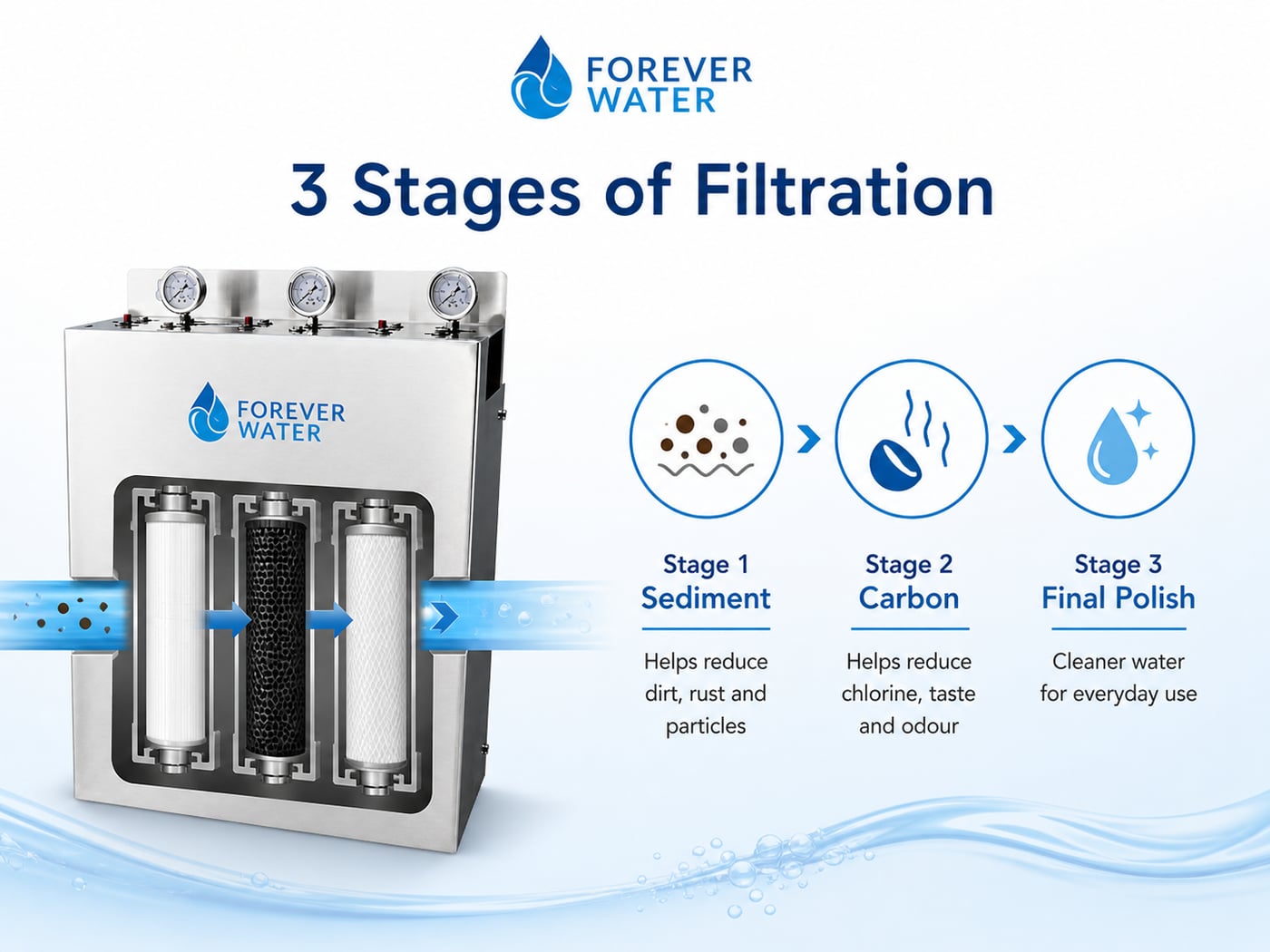
Stage type 1: Sediment / mechanical
What it is: A physical mesh or wound-fibre filter, usually rated 5 or 10 microns.
Removes: dirt, sand, rust flakes, sediment, anything you can theoretically see if you looked closely enough. Protects the next stages from clogging.
Doesn't remove: anything dissolved (chemicals, salts, gases). It's just a strainer.
Best for: tank water, bore water, any supply that visually has particles in it.
Stage type 2: Activated carbon (granular or block)
What it is: Highly porous charcoal — usually coconut shell-derived, sometimes coal — that adsorbs organic compounds onto its surface area. A teaspoon of activated carbon has the surface area of an Olympic swimming pool.
Removes: chlorine (essentially 100% with adequate contact time), chloramine, bad tastes, odours, volatile organic compounds (VOCs), pesticides, herbicides, partial PFAS reduction (60–90%), some pharmaceutical residues.
Doesn't remove: dissolved minerals, sodium, fluoride (mostly), bacteria, viruses, or anything inorganic.
Best for: the chlorine-taste problem most Australian tap water has, plus general "make this water taste better" jobs.
Stage type 3: Reverse osmosis (RO)
What it is: A semi-permeable membrane with pore sizes around 0.0001 microns — small enough to block almost everything except water molecules.
Removes: 95–99% of dissolved solids, fluoride, lead, microplastics, bacteria, viruses, PFAS, nitrates, sulphates, chromium, hardness minerals, basically everything.
Doesn't remove: some dissolved gases (chloramine residue if not pre-treated). Will not handle high sediment loads — needs a sediment pre-filter.
Trade-off: Wastes 1–4 L of water per L produced (rejected as concentrated brine). Slow flow rate (1–2 L/min). Strips beneficial minerals along with the bad stuff — most RO setups remineralise after.
Best for: drinking water purification at point-of-use. Not whole-house at typical flow rates.
Stage type 4: UV-C sterilisation
What it is: A 254 nm ultraviolet lamp the water flows past. UV-C destroys the DNA of any micro-organism passing through.
Kills: 99.99% of bacteria, viruses, protozoa (giardia, cryptosporidium).
Doesn't: remove or change anything else. UV is a final-stage polish, not a primary filter.
Best for: tank water, bore water, anywhere bacterial contamination is possible. Also a belt-and-braces final stage on an otherwise clean filter chain.
Stage type 5: Ion exchange (softeners, fluoride media, anion resins)
What it is: Resin beads that swap one ion for another. Conventional softeners swap calcium/magnesium for sodium. Specialised resins target fluoride, lead, or specific PFAS species.
Removes: hardness (most common), fluoride (specific media), some heavy metals, specific PFAS species at very high efficiency.
Trade-off: Adds the swap-ion (usually sodium) to the water. Needs regular regeneration with brine.
Stage type 6: Polyphosphate dosing
What it is: Tiny dose of food-grade polyphosphate that doesn't remove hardness but keeps calcium ions in solution so they can't deposit as scale.
Useful for: protecting hot water systems and appliances in hard-water areas without the maintenance overhead of an ion-exchange softener.
How real systems combine these
Forever Water A10 (atmospheric water generator)
1. Electrostatic air filter → 2. Pre-Carbon (10 µm) → 3. Post-Carbon (5 µm) → 4. Reverse Osmosis → 5. TCR Carbon → 6. Mineral Pouch (optional) → 7. 3× UV-C lamp.
Designed for atmospheric water (already very clean) plus belt-and-braces protection. Output <10 ppm dissolved solids.
Forever Water Whole House HPF-3
1. Sediment (20" × 4.5") → 2. Activated Carbon Block (20" × 4.5") → 3. Polyphosphate Polish (20" × 4.5").
Designed for whole-house flow rates. Removes sediment + chlorine + chemicals, prevents scale. No RO (impractical at house flow). UV optional add-on.
Typical under-sink unit
Sediment → Carbon Block → optional RO → optional UV. Smaller cartridges, drinking-water flow only.
Picking by concern
- Bad chlorine taste: any carbon filter is enough
- Microplastics & PFAS worry: needs RO or specific PFAS-rated carbon block
- Hard water: polyphosphate or softener
- Bacteria (tank/bore): sediment + carbon + UV
- Everything at every tap: whole-house with sediment + carbon + polyphosphate (our HPF-3)
- Ultra-pure drinking water without plumbing: atmospheric water generator (our A10)
Read next: Whole-house vs. under-sink · PFAS in Australian water