In late 2025 the Australian Federal government tightened the national drinking water guideline for PFOS + PFHxS from 0.07 µg/L down to 0.004 µg/L — a 17× reduction. That sounds tiny, but it's the most consequential change to Australian drinking water guidelines in two decades. Here's what it means.
What PFAS actually is
"Forever chemicals" is a group of around 14,000 synthetic compounds — PFOA, PFOS, PFHxS, GenX and many others. They were used since the 1950s in firefighting foam, non-stick cookware, waterproof clothing, food packaging, stain-resistant carpet, and as industrial lubricants. They're called "forever" because they don't break down in the environment or in the human body.
How they got into Australian water
Three main vectors:
- Defence bases & airports using PFAS-based firefighting foam. Williamtown (NSW), Oakey (QLD), Tindal (NT), Edinburgh (SA), Pearce (WA) and many regional airports have documented contamination of nearby groundwater.
- Industrial sites with PFAS in their supply chain — manufacturing, plating, textile.
- Atmospheric deposition — at trace levels, PFAS now appears in rainwater globally (yes, including in Australia).
Health concerns
The Australian Government's 2025 expert review (the same one that triggered the new guideline) cited:
- Suppression of immune response, particularly to vaccines
- Mild liver enzyme changes
- Altered cholesterol metabolism
- Potential link to thyroid function changes
- "Probable" links to certain cancers (kidney, testicular) at high exposures
These risks are dose-dependent. Australians at typical exposure levels are not at acute risk — but PFAS bioaccumulates, so the case for reducing daily intake is straightforward.
What's in your tap right now?
Most Australian capital cities test below the new 0.004 µg/L threshold for PFOS+PFHxS. The exceptions are:
- Suburbs near Williamtown RAAF (NSW) — historic readings well above the new limit
- Oakey, QLD & surrounds — same
- Some bores in regional Victoria, NSW and SA — see your local water authority's annual quality report
If you live in a metro area on mains water, current PFAS levels in your tap are most likely well below the new guideline. But "below the limit" is not the same as zero.
How to actually remove it
This matters: not all water filters remove PFAS. The methods that work:
- Activated carbon block (long contact time) — reduces PFAS by 70–90%
- Reverse osmosis — reduces PFAS by 95%+
- Ion exchange resin — reduces specific PFAS species by 99%+
Methods that do not work: boiling (concentrates PFAS), freezing/distillation alone, simple sediment filters, chlorination.
What we do
Both Forever Water systems are PFAS-aware:
- The A10 bypasses tap water entirely — atmospheric water naturally contains far less PFAS than treated tap, and the 7-stage filter chain handles whatever residual is present.
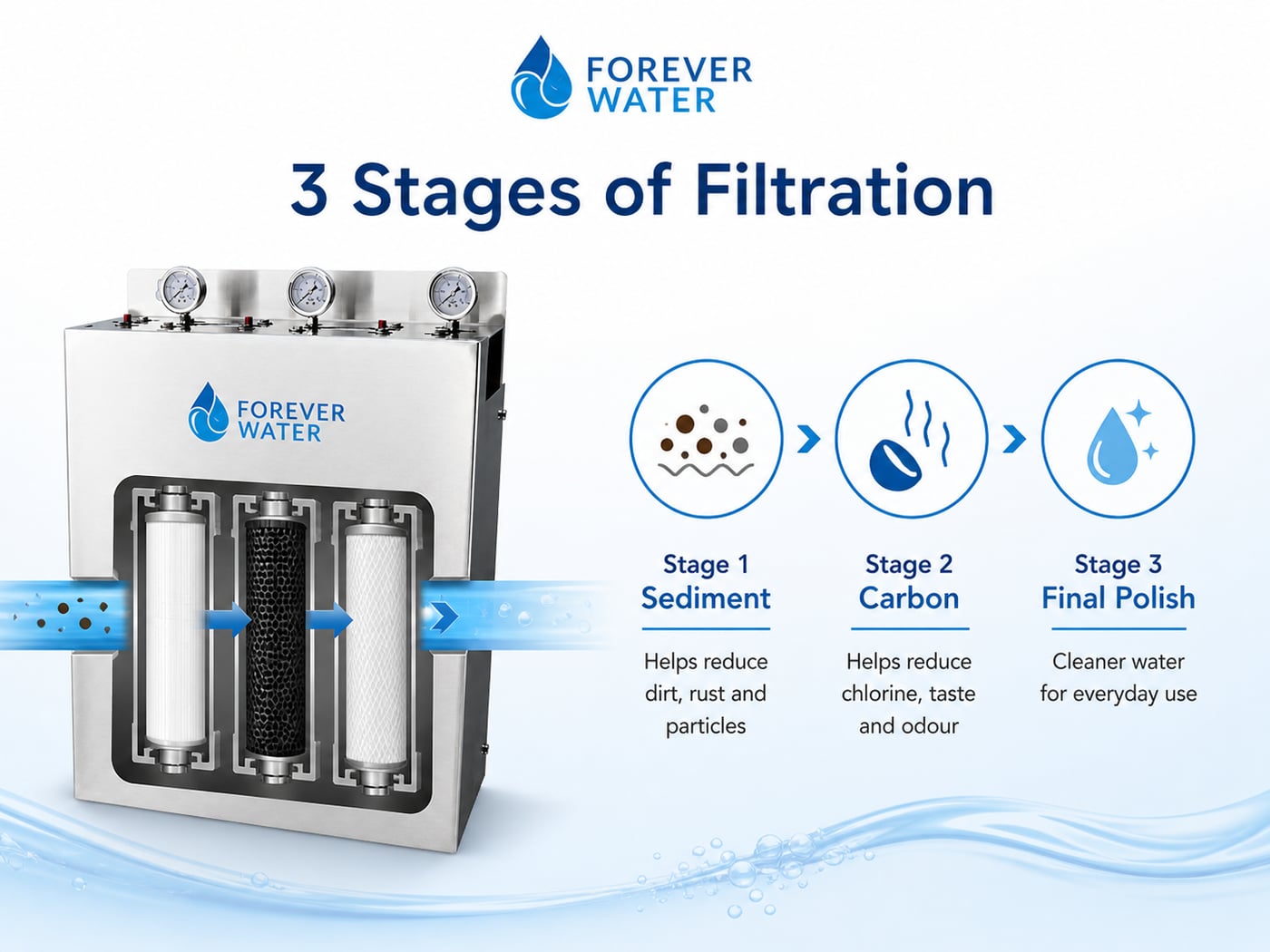
- The whole-house HPF-3 uses a high-grade activated carbon block as its second stage, designed for organic-chemical contaminant reduction including PFAS-class compounds.
Practical takeaway for an Australian household
Three things:
- Check your local water authority's annual report. Search "[your suburb] water quality report 2025" — most include PFAS now.
- If you're near a defence base or live on tank water in an industrial-adjacent area, get a NATA-accredited test (~$150). Worth it.
- If your readings are at all elevated — or if you just want margin — use a filter rated for PFAS reduction. Activated carbon block at minimum.
Read next: Is Australian tap water safe? · Filter choices decoded — what each stage actually removes